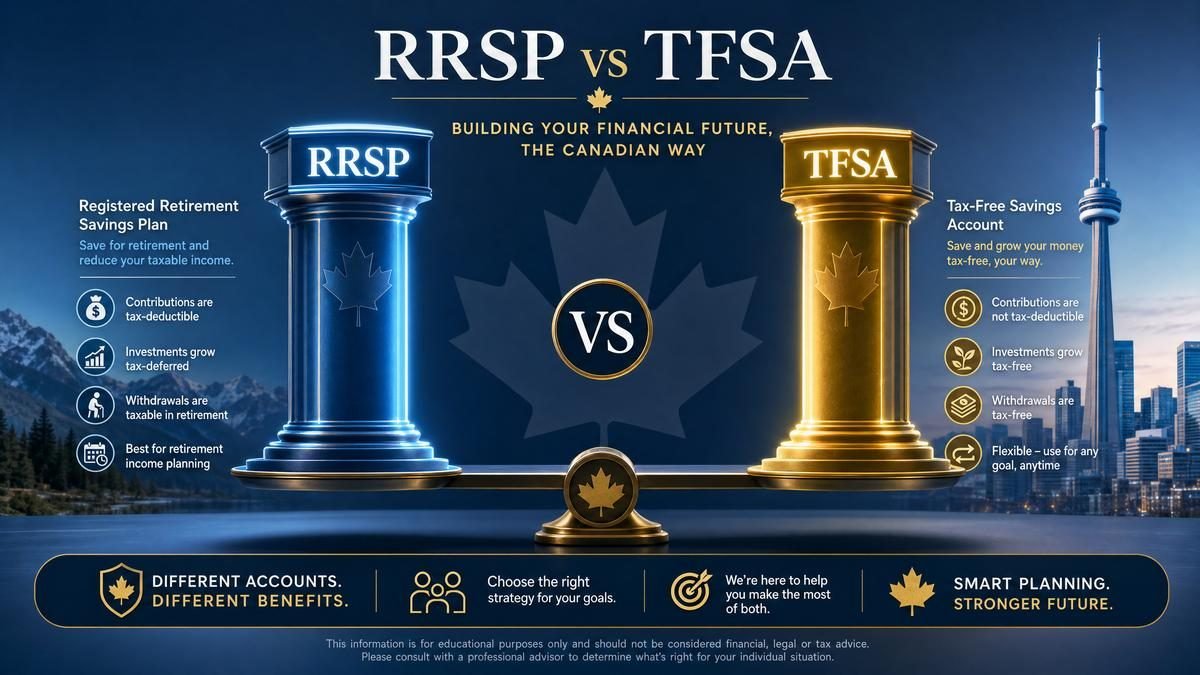
Choosing between an RRSP (Registered Retirement Savings Plan) and a TFSA (Tax-Free Savings Account) is one of the most important financial decisions Canadians face each year. Both accounts offer powerful tax advantages, but they work very differently — and the right choice depends on your income, goals, and stage of life. At BOMCAS Canada, our Professional Tax Accountants in Edmonton help clients across Alberta and all of Canada make the most of these registered savings vehicles every tax season.
This comprehensive guide breaks down the RRSP vs TFSA debate in plain language, covering contribution limits, tax treatment, withdrawal rules, and the strategies that work best for different types of Canadians in 2026.
What Is an RRSP?
A Registered Retirement Savings Plan (RRSP) is a government-registered account that lets you save for retirement while reducing your taxable income today. When you contribute to an RRSP, the amount you contribute is deducted from your taxable income for that year — meaning you pay less income tax right now. The money inside your RRSP grows tax-deferred: you do not pay tax on interest, dividends, or capital gains until you withdraw the funds.
The trade-off is that every dollar you withdraw from an RRSP is fully taxable as income in the year you take it out. The strategy works best when you contribute during your high-income working years and withdraw in retirement, when your income — and therefore your tax rate — is lower. This tax-deferral mechanism is the core advantage of the RRSP.
RRSPs must be converted to a Registered Retirement Income Fund (RRIF) or annuity by December 31 of the year you turn 71. After conversion, you must withdraw a minimum amount each year, which is included in your taxable income.
Key RRSP Features
- Contributions are tax-deductible — they reduce your taxable income in the year made
- Investments grow tax-deferred inside the plan
- Withdrawals are fully taxable as income
- Contribution limit: 18% of prior year earned income, up to the annual maximum
- Unused room carries forward indefinitely
- Must be converted to RRIF or annuity by age 71
- Home Buyer's Plan (HBP): withdraw up to $35,000 tax-free to buy your first home (must repay within 15 years)
- Lifelong Learning Plan (LLP): withdraw up to $10,000/year for education (must repay within 10 years)
What Is a TFSA?
A Tax-Free Savings Account (TFSA) is a registered account that lets Canadians save and invest money completely tax-free. Unlike the RRSP, TFSA contributions are made with after-tax dollars — there is no tax deduction when you contribute. However, all growth inside the account (interest, dividends, capital gains) is completely tax-free, and withdrawals are also tax-free at any time, for any reason.
The TFSA is one of the most flexible savings tools available to Canadians. You can use it for short-term goals like an emergency fund or vacation, medium-term goals like a down payment, or long-term goals like retirement. Because withdrawals do not count as income, they do not affect your eligibility for income-tested government benefits such as Old Age Security (OAS) or the Guaranteed Income Supplement (GIS).
Any amount you withdraw from your TFSA is added back to your contribution room on January 1 of the following year — meaning you can re-contribute those funds later without penalty.
Key TFSA Features
- Contributions are NOT tax-deductible
- All investment growth is completely tax-free
- Withdrawals are tax-free at any time, for any purpose
- Withdrawn amounts are restored to your contribution room the following year
- Annual contribution limit set by the CRA each year
- Unused room accumulates from the year you turn 18 (or 2009, whichever is later)
- No age limit for contributions — you can contribute at any age
- Withdrawals do not affect income-tested government benefits
Key Differences: RRSP vs TFSA
The fundamental difference between an RRSP and a TFSA comes down to when you get the tax benefit. With an RRSP, you get a tax deduction now but pay tax when you withdraw. With a TFSA, you pay tax on the money before contributing, but never pay tax on it again — including all the growth.
| Feature | RRSP | TFSA |
|---|---|---|
| Tax deduction on contribution | Yes | No |
| Investment growth | Tax-deferred | Tax-free |
| Withdrawals taxed | Yes — as income | No |
| Withdrawal room restored | No | Yes (next January) |
| Age limit | Must convert at 71 | No age limit |
| Affects government benefits | Yes (withdrawals = income) | No |
| Best for | High-income earners, retirement | Any income, any goal |
| Spousal account available | Yes | No |
Contribution Limits for 2026
Understanding your contribution limits is essential to avoid over-contribution penalties, which can be costly. The Canada Revenue Agency (CRA) sets these limits annually, and your personal room is tracked in your CRA My Account.
RRSP Contribution Limit 2026
Your RRSP contribution limit for 2026 is 18% of your 2025 earned income, up to a maximum of $32,490 (the 2026 dollar limit), minus any pension adjustment. Unused RRSP room from prior years carries forward and is added to your current limit. You can find your exact limit on your 2025 Notice of Assessment from the CRA.
TFSA Contribution Limit 2026
The TFSA annual contribution limit for 2026 is $7,000. If you have never opened a TFSA and have been a Canadian resident aged 18 or older since 2009, your total cumulative contribution room in 2026 is $102,000. Any amounts withdrawn in prior years are added back to your room on January 1 of the following year.
Which Account Is Right for You?
The answer depends primarily on your current tax bracket compared to your expected tax bracket in retirement. Here is a practical framework our personal tax accountants use when advising clients:
Prioritize RRSP If:
- You are in a high tax bracket now (taxable income above $55,000 in Alberta)
- You expect to be in a lower tax bracket in retirement
- You want to reduce your current year tax bill significantly
- You are a first-time home buyer planning to use the Home Buyer's Plan
- You want to income-split with a lower-income spouse using a Spousal RRSP
Prioritize TFSA If:
- You are in a low or moderate income tax bracket
- You expect your income to increase significantly in the future
- You need flexible access to savings without tax consequences
- You are retired and receiving OAS or GIS (TFSA withdrawals do not reduce benefits)
- You have already maxed out your RRSP contributions
- You are saving for a short-term or medium-term goal (emergency fund, vacation, car)
A Practical Example
Consider two Canadians, both earning $80,000 per year in Alberta. Sarah is 35 and expects her income to grow to $120,000 by retirement. She should prioritize her RRSP now, locking in deductions at her current 30%+ marginal rate, and use her TFSA for emergency savings. Michael is 28, earns $50,000, and expects his income to grow substantially. He should prioritize his TFSA now, since his current tax rate is lower, and shift more to RRSP as his income rises.
Using Both RRSP and TFSA Together
For most Canadians, the optimal strategy is to use both accounts in a coordinated way. Our tax planning specialists at BOMCAS Canada frequently recommend the following approach:
- Build an emergency fund in your TFSA first. Having 3–6 months of expenses in a tax-free, accessible account gives you financial security without tax consequences.
- Maximize RRSP contributions during high-income years. When your marginal tax rate is at its peak, RRSP deductions provide the greatest tax savings.
- Reinvest your RRSP tax refund into your TFSA. This powerful strategy lets you benefit from both the RRSP deduction and tax-free TFSA growth simultaneously.
- Use TFSA for investments that generate highly taxed income. Interest income and foreign dividends are taxed heavily in non-registered accounts but grow completely tax-free inside a TFSA.
- Draw from TFSA first in retirement to manage your taxable income and protect OAS/GIS eligibility.
Common Mistakes to Avoid
Even experienced savers make costly mistakes with their RRSPs and TFSAs. Here are the most common errors our accountants see:
- Over-contributing to a TFSA after withdrawals. Many Canadians re-contribute withdrawn amounts in the same calendar year, triggering the 1% monthly penalty. You must wait until January 1 of the following year.
- Withdrawing from an RRSP before retirement. Early RRSP withdrawals are taxed immediately at your marginal rate, and the contribution room is permanently lost (unlike a TFSA).
- Holding low-growth investments in a TFSA. Since all TFSA growth is tax-free, you maximize the benefit by holding higher-growth investments (equities, ETFs) rather than low-yield savings accounts.
- Ignoring the Spousal RRSP for income splitting. Contributing to a Spousal RRSP can significantly reduce your household's tax burden in retirement.
- Not tracking contribution room. Always verify your available room in CRA My Account before contributing to either account.
Frequently Asked Questions
Should I contribute to an RRSP or TFSA first?
If you are in a high income tax bracket (above 30%), contribute to your RRSP first to get the immediate tax deduction. If you are in a lower bracket or expect your income to rise, prioritize your TFSA for tax-free growth and flexible withdrawals. Many Canadians benefit from contributing to both each year.
Can I have both an RRSP and a TFSA?
Yes. Most Canadians benefit from using both accounts together. The RRSP is ideal for retirement savings and tax deferral, while the TFSA provides flexible, tax-free savings for any goal. There is no rule preventing you from contributing to both in the same year.
What is the TFSA contribution limit for 2026?
The TFSA annual contribution limit for 2026 is $7,000. If you have never contributed to a TFSA and have been eligible since 2009, your cumulative room could be as high as $102,000. Check your exact room in CRA My Account.
What happens to my RRSP when I turn 71?
You must convert your RRSP to a Registered Retirement Income Fund (RRIF) or purchase an annuity by December 31 of the year you turn 71. After conversion, you must withdraw a minimum amount each year, which is fully taxable as income. There is no age limit for TFSA contributions.
Are TFSA withdrawals counted as income?
No. TFSA withdrawals are completely tax-free and do not count as income for any purpose. They do not affect your eligibility for income-tested benefits such as Old Age Security (OAS), Guaranteed Income Supplement (GIS), or Canada Child Benefit (CCB).
Get Expert Tax Advice from BOMCAS Canada
Deciding between an RRSP and TFSA — or how to balance both — is a highly personal decision that depends on your income, goals, and tax situation. BOMCAS Canada's Professional Tax Accountants in Edmonton provide personalized personal tax planning and tax strategy services to help you maximize every dollar you save. Whether you are just starting out or approaching retirement, our team is here to help you make the right choice.